
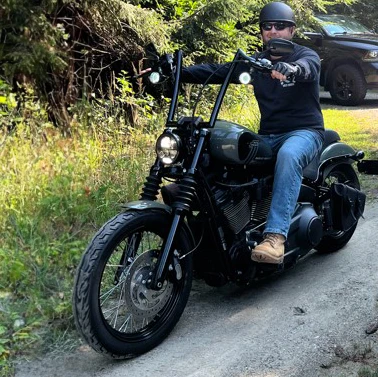
Employee Spotlight: Brad Lemont, P.L.S., E.I.T.
Brad Lemont, Survey Manager at Merrill Engineers and Land Surveyors, always suspected that engineering would be part of his future.
Like many kids, growing up, he enjoyed building things—and sometimes taking them apart to see how they worked. That curiosity eventually led him to study civil engineering. During school breaks and summer vacations, he also worked in land surveying, a field that naturally complemented what he was learning in the classroom.
“I liked the CAD aspect, I liked the fieldwork aspect, and then seeing how everything came together,” Brad said. “That’s where I think I caught the bug.”
After spending a few years working in civil engineering, he realized it was not the right fit. But, surveying was.
“It was an easy shift for me to focus my career trajectory toward land surveying,” he said. “I stayed in that lane, and here we are.”
Brad joined Merrill in 2014. Today, his work happens primarily on the back end of the surveying process, where he brings research, field measurements, and technical judgment together to produce the final deliverable.
The part of the job he enjoys most: completing the picture.
No Cookie-Cutter Survey
People generally know that land surveyors exist. Brad has found that they do not always understand the full range of what surveyors do—or that the right survey depends on what the client is trying to accomplish.
“There are a lot of different things we can do as a surveyor to survey your land,” he said. “There’s no cookie-cutter survey of your lot.”
A homeowner may want to build an addition, install a fence, resolve a boundary question, or prepare for another type of property improvement. Each goal can require a different scope of work. Starting with a technical explanation of every available option, however, can quickly become overwhelming.
Brad has learned to begin the conversation somewhere simpler.
“I like to flip the conversation 180 degrees and start with what they’re trying to do,” he said. “Then I can back into the appropriate level of survey that we need to get for them.”
That question—what are you trying to do?—allows Brad to identify the service that will actually help, rather than asking a client to choose from options they may not fully understand.
The conversation is especially important with residential clients who may be hiring a surveyor for the first time. Commercial and construction clients often know exactly what they need because they have been through the process before. Homeowners typically need more guidance.
“I feel like I owe it to a client to explain what we’re doing to ensure that they get exactly what they need,” Brad said.
Completing the Picture
By the time a survey crew arrives at a property, the project is usually already underway.
The office team may have researched the property, built preliminary property lines in CAD, and prepared the GPS equipment to locate survey control in the field. That preparation gives the field crew the best opportunity to work efficiently and collect the information the project needs.
“Every single job, almost without question, starts in the office,” Brad said. “By the time we show up at your door, we’re usually a couple of steps into the process.”
Once the on-site work is complete, the information returns to the office for processing and analysis. Research and field data must be compared, questions resolved, and the final plan or other deliverable produced.
Brad began his career on the field side of that process. He was part of a survey crew, gathering data and searching for the control points that allow surveyors to accurately establish locations. That experience now informs his work on the other side of the process: making the pieces fit and producing the final deliverable.
“I get to do the cool part and put it all together, identify the challenges, and work my way through them,” Brad said.
For him, the satisfaction comes from seeing what the initial research suggested, comparing it with what the crew found in the field, and turning that combined information into a clear result.
“Putting everything together, seeing what was pulled in research versus what was gathered in the field, and kind of completing the picture—that would be my favorite part,” he said.
The Challenge of Airports
Some of Brad’s most demanding work has involved airports.
Merrill has completed surveying assignments at airports in communities including Plymouth, Mansfield, Chatham, Marshfield, and Nashua. Although the settings may have something in common, every assignment begins with a different objective or question to resolve.
Airport work can make both the field and office portions of a survey challenging. On the back end, Brad must interpret the information, identify the real problem, and resolve the particular wrinkle that project presents.
“The fieldwork can be stressful and fun,” he said. “And then the back end of things, where I get involved, can also be stressful and fun for a number of different reasons.”
Experience helps, but it does not make these assignments routine. Each one demands a fresh understanding of the client’s objective and the conditions surrounding the work.
“As much as I’d like to say I know how to approach them, they all seem to be different,” Brad said. “They bring their own little wrinkle to keep us all on our toes.”
That combination—difficult enough to be interesting and solvable through careful work—is part of surveying’s appeal.
Learning a Profession by Working Beside People
Brad’s introduction to surveying came through a family connection. As a teenager, he spent a summer helping a land surveyor who was his father’s friend. What began as a way to stay busy and earn some money became the start of a career.
Later, Shane Brenner, a survey director at Brad’s former company, became an important mentor. Shane eventually left that firm for Merrill, and Brad followed a few years later.
“He was a fantastic mentor for me,” Brad said. “I can attribute much of my success to him, I feel.”
Surveying is a profession people can study in school, but relatively few enter the field with a surveying-specific education. Much of the knowledge comes from the job, which makes questions, teaching, and shared experience essential.
Brad has now experienced that exchange from both sides.
“If you’re just starting out, that lends itself to asking a lot of questions,” he said. “On the flip side, because people don’t have a lot of experience in this field, you’re going to get asked a lot of questions if you’re on the more experienced side of things.”
When coworkers ask him for advice or guidance, he tries to make himself available.
“I’ve always tried to be open to that,” Brad said. “In general, I do enjoy it.”
If he could offer his younger self one piece of career advice, it would be to recognize the right path sooner: leave civil engineering earlier and pursue a surveying education as soon as he knew surveying was what he wanted to do.
Keep It Professional, but Keep It Light
Merrill’s culture is one reason Brad has stayed since 2014. People can be themselves, enjoy their coworkers, and bring some personality into the workday without losing sight of their responsibility to clients.
“Keep it professional, but keep it light,” Brad said. “They do a pretty good job of that here.”
Maintaining that connection takes intention as Merrill operates across multiple offices and many employees spend their days in the field. Company-wide gatherings—including a golf outing, a harbor cruise, and the holiday party—give colleagues who may not work together regularly a chance to reconnect.
Golf teams are deliberately mixed across offices, Brad said, so employees spend time with people outside their usual circles.
“Josh does a really good job of trying to orchestrate company-wide meetups or outings so that we all get to see each other often enough that we don’t become strangers,” he said.
The result is a workplace that feels relaxed without being careless and connected despite the physical distance between teams.
“You can be yourself here,” Brad said. “That definitely helps clear the air of any stuffy office culture that seems to be the norm in other places.”
Family First, Then the Open Road
Ask Brad how he would spend more of his time, and his answer begins close to home.
His daughter plays softball and soccer. His son plays baseball and takes on American Ninja Warrior-style obstacles. Brad would like more opportunities to volunteer, coach, and be there for all of it.
“I’d spend as much time as I possibly could with my kids,” he said.
Once they are grown and off on lives of their own, Brad has another plan waiting: travel.
“I’m not a well-traveled man,” he said. “If I could incorporate those travels with my motorcycle, I would probably do that.”
Brad has covered much of the East Coast, but the West is still largely unexplored. He can picture himself following the Pacific coastline by motorcycle, with no need to take the quickest route.
The Hoover Dam would be an essential stop.
“I would love to see the Hoover Dam in person someday,” he said. “I understand it to be one of the biggest engineering marvels ever.”
Outside the United States, Greece is also on his list. Friends have returned with glowing reviews, and Brad would like to experience its food, history, and architecture for himself.
For now, the motorcycle journey can wait. There are games to attend, obstacles to cheer through, and time with his children that Brad would not trade for any destination.