

Employee Spotlight: Richard Cheverie
Richard Cheverie, Land Surveyor and AutoCAD Technician at Merrill Engineers and Land Surveyors, always expected to work in construction. He just did not know exactly where that path would take him.
In vocational school, Rich studied carpentry and cabinetmaking. He liked building and working with his hands, and he figured some form of construction would be part of his future. When his parents encouraged him to continue his education, he enrolled in an associate degree program in architectural design at Massasoit Community College.
“If I was going to do building, at least that would give me a little bit more knowledge of the other side of building,” Rich said. “Not just swinging a hammer, but how does all this stuff come together design-wise?”
By the time he finished college, however, Rich knew he did not want to spend every day in front of a computer. He wanted to be outside.
AutoCAD was becoming increasingly important at the time, and his college encouraged students to find internships that would give them practical drafting experience. Through a friend, Rich connected with a small land surveying company and began drafting.
Then someone asked whether he would be willing to go into the field.
“I said, ‘I’ll do whatever you want me to do,’” Rich recalled.
The combination fit. His architectural education helped him read plans. His carpentry and construction background helped him understand what builders needed. Surveying connected the drawings on the screen to the work happening on the ground.
“If you don’t understand what you’re looking at, it’s just a bunch of lines and numbers,” Rich said. “Because of my upbringing, from the time I was 12, 13, or 14 years old getting into building, I’ve always kind of been involved in that.”
That background is one reason construction layout remains an important part of his work today.
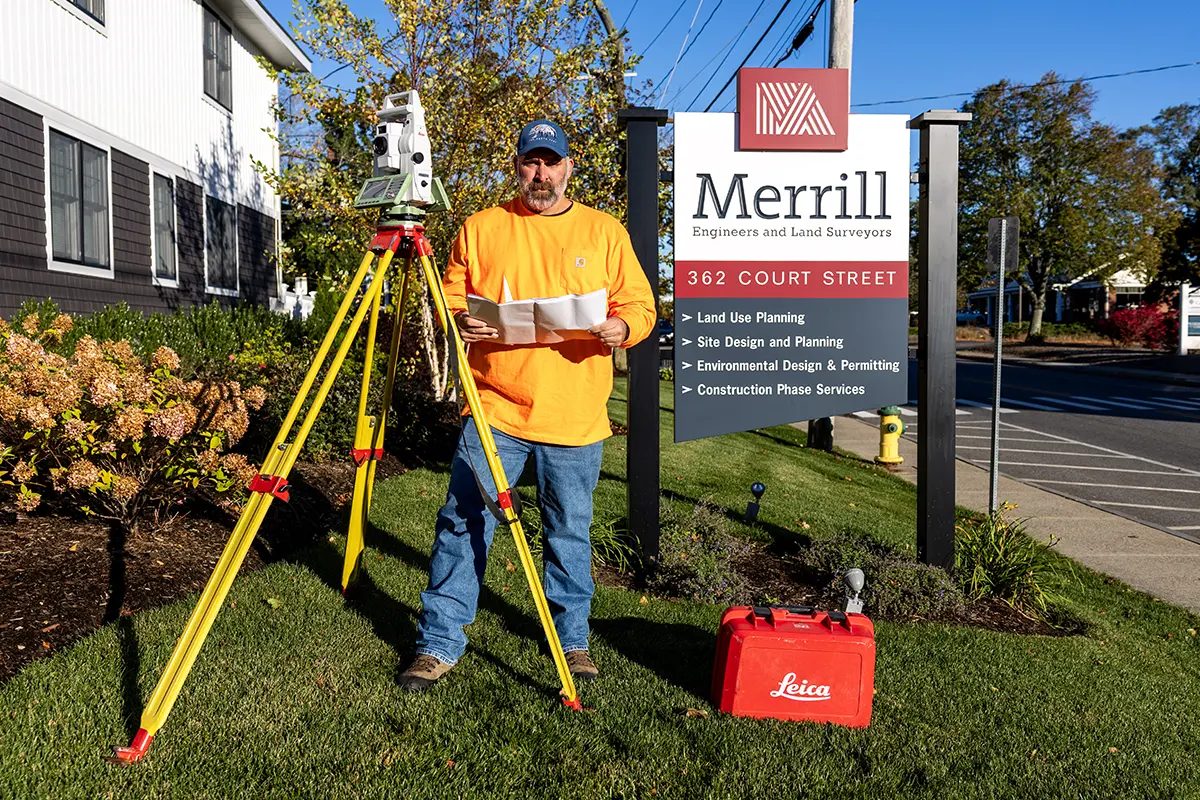
The Work Before the Tripod
When people see a survey crew arrive, unload equipment, and begin taking measurements, the work can look surprisingly quick. What they do not see are the hours of research and calculations that may have already taken place.
“People see us arrive at their property or at their job site, and they just kind of assume that we have some sort of Terminator 2-like glasses on—that we can see everything,” Rich said. “Like I can calculate your property line through my sunglasses.”
In reality, a survey may begin with deeds, recorded plans, roadway layouts, research sketches, and neighboring property information. If a clear plan does not exist, the work can require reading multiple deeds and calculating how surrounding properties fit together.
That preparation helps uncover potential problems before they disrupt a project. An unexplained overlap in property lines, for example, can affect setbacks, permitting, and what a client can build.
“There may already be four or five hours into a project before we even get the equipment in the truck,” Rich said.
The fieldwork may also extend well beyond the property being surveyed. A deed might refer to a roadway layout established by monuments located hundreds or even thousands of feet away.
Clients occasionally wonder why Rich is working at the opposite end of their street.
“Until I know where that roadway layout is, I don’t know where your property is,” he said. “I start from far away and work my way toward it.”
Modern equipment makes the visible part of surveying more efficient, but it does not replace the research, judgment, and due diligence behind it.
“It’s more than just showing up, throwing a tripod up, and getting to work,” Rich said.
Seeing a Project All the Way Through
One of Rich’s favorite parts of working at Merrill is the opportunity to stay involved throughout the life of a project.
It might start with a homeowner calling to ask whether a new house, addition, or swimming pool is possible. Rich listens to what the client wants, considers the site, reviews the regulations and permitting requirements, and helps identify the surveys and plans the project will need.
From there, he may prepare a proposal, complete the fieldwork, draft the plan, and help move the project toward its final as-built submission.
“We have that ability to start something with a client and see it all the way through until we’ve submitted an as-built with the town and they’re moving into their new house or they’re swimming in their pool,” Rich said.
Not every idea will receive approval, and not every property can support exactly what its owner initially imagined. But when the project works, Rich gets to see a technical process become something meaningful in a client’s life.
“It’s really nice to be hands-on with these folks while they’re going through this process that they really had no idea what they needed to do at the beginning,” he said.
The reward comes when a client reaches the other side of that process and can finally enjoy what they worked toward.
“It’s really nice to get paid doing something that somebody at the end is like, ‘Oh man, this is great. This is awesome. We are so excited about this.’”

Projects That Stay With You
After nearly two decades at Merrill, Rich has worked on projects ranging from private homes to schools, airports, and major infrastructure.
One of the most challenging took place on the Tobin Bridge around 2009. Rich and a colleague were assigned to profile the bridge’s expansion joints. Because the work could only happen when traffic was lighter, their shifts ran from approximately 10 at night until 6 in the morning.
They worked in the dark under bridge lighting, with cars continuing to pass in nearby lanes.
“It was definitely a challenging job, one that you really didn’t want to do,” Rich said. “But it’s like, ‘Hey guys, guess what? You’re it.’ So we’ve got to get this done.”
Other projects stand out for a different reason: Rich gets to see what the survey and layout work helped create.
Schools he helped lay out and other completed projects become familiar landmarks. Whenever the family drives past one, Rich points it out—again.
“My kids and my wife go nuts because every time we go by there, I let them know that I worked on that building,” he said. “They get kind of tired of hearing that.”
For Rich, though, being able to point to a finished place is part of the satisfaction. The research, plans, measurements, and layout have become something tangible.
Use Your Ears More Than Your Mouth
Rich is approaching 20 years at Merrill, but he does not describe experience as reaching a point where there is nothing left to learn.
He credits parents, grandparents, coaches, engineers, surveyors, coworkers, and others throughout his career with shaping how he works. Instead of naming one mentor, he talks about trying to learn something from everyone.
“Everybody knows something different than I do—knows more than I do in some way, shape, or form,” he said. “I try to draw as much as I can out of other folks that have a wealth of knowledge.”
His advice to someone entering the profession follows the same principle.
“It’s easy, the more you learn, to think that you know a lot,” Rich said. “But there are people out there who have forgotten more than you know.”
A degree and a strong academic record provide a foundation. The next stage of learning happens by paying attention to experienced people and understanding how the work operates outside the classroom.
“Get on a team and listen to what that team has to say—and really listen,” he said. “Don’t just hear it. Listen to it.”
Rich now tries to offer younger coworkers the same kind of support he received. If someone needs more field experience or help connecting classroom knowledge to real conditions, he is glad to work alongside them.
“I was that new person 25 years ago,” he said. “I was that guy who didn’t know which end of the rod to hold or what a transit was.”
His concise advice: “Use your ears more than your mouth.”
A Team You Know
Rich joined Merrill in 2007, before Josh Bows became the company’s owner. The two first worked together as colleagues under founder Bob Merrill.
When Josh eventually took ownership, Rich appreciated that the company was being led by someone who already understood both the work and the people doing it.
“It was somebody who was one of us,” Rich said. “It was part of the team, part of the family. It wasn’t just some rich guy from out of town who came in and said, ‘I think I’d like to own an engineering company.’ It was somebody who helped build the company.”
That continuity is part of what Rich believes has allowed Merrill to grow while maintaining close working relationships. Company outings give coworkers and their families opportunities to spend time together without making the event about work.
Inside the office, Rich makes a point of learning about the people around him—their families, interests, accomplishments, and what is happening in their lives.
“Life is short, and I don’t want to be on a team with a bunch of people that I don’t know anything about,” he said. “I care about everybody that we work with.”
That sense of connection does not make the projects less demanding. It makes the demanding work easier to take on together.
“You get some crazy stuff. You get some challenging jobs,” Rich said. “You keep your blade sharp, but you also have a little bit of fun at the same time.”
After nearly 20 years, Rich is not looking for another role—or another company.
“If you care about the people that you work with, it’s easier to show up to go to work,” he said. “Why would I want to go anywhere else?”

A Farm, Some Tractors, and Miniature Cows
There is one opportunity that might persuade Rich to leave surveying: winning the lottery.
Rich and his wife have talked about eventually finding a farm somewhere between Massachusetts and her home state of Louisiana. She would like to raise miniature cows. Rich likes the idea of having a large piece of land, playing with tractors and four-wheelers, and watching the sun come up over the landscape.
“If I ever win the lottery, I’m going to say, ‘Josh, it’s been great, but I’m off to become a mini-cow farmer somewhere in Tennessee.’”
For someone whose career has been built around understanding land, helping people make plans for it, and turning lines and numbers into something real, it is a fitting dream: a place of his own, a few machines to keep busy, and a small herd waiting outside.